
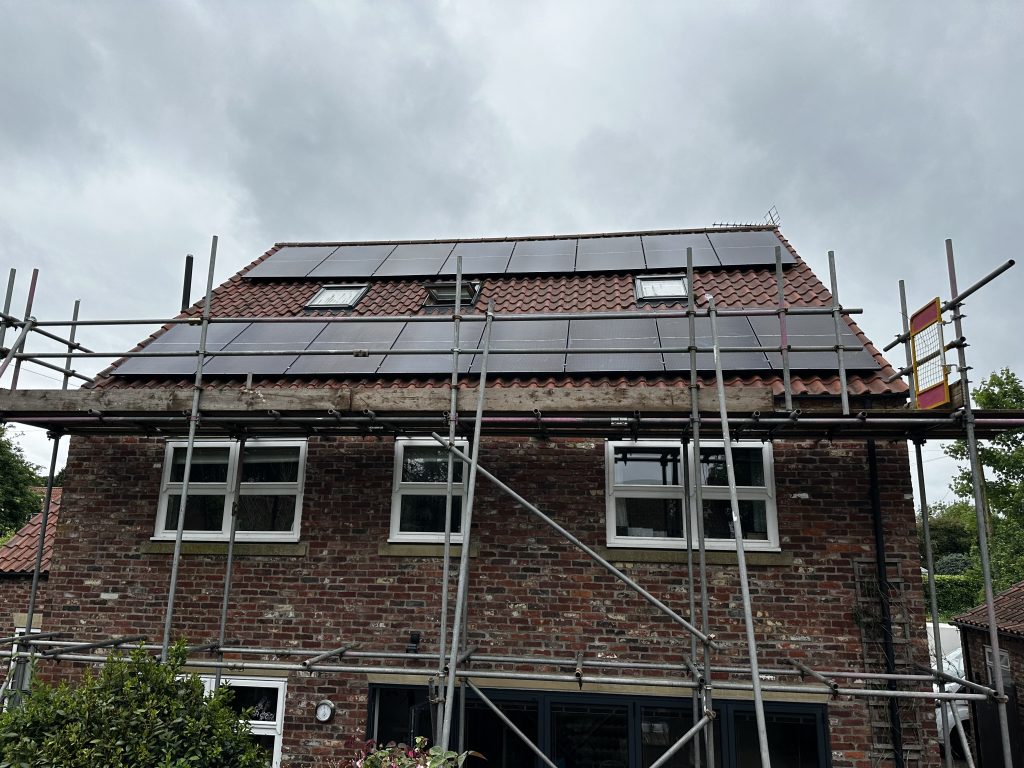
Solar panels are designed to provide renewable electricity for many years, but there comes a point when homeowners and businesses may need to decide whether to repair an existing solar system, replace individual components or install a completely new system.
For some properties, the existing solar panels may still be performing well and only a particular component, such as the inverter, may need attention. For others, an older system may no longer provide the level of generation, monitoring or energy flexibility that the property now requires.
This is particularly relevant as UK properties increasingly combine solar PV, battery storage and EV charging. A system that was appropriately sized several years ago may no longer match the property’s current electricity consumption.
So, when is it better to work with an existing installation, and when does a new solar PV system make more sense?
When Does Solar Panel Replacement Become Worth Considering?
Solar panels can continue generating electricity for decades, but their performance can gradually change as they age.
If an existing installation is still producing electricity reliably, replacement may not be necessary.
However, there are situations where upgrading or replacing part of the system can make sense.
These can include:
- Significant reduction in solar generation
- Damaged panels
- Repeated system faults
- An ageing inverter
- Outdated monitoring equipment
- Changes in electricity consumption
- Plans to add battery storage
- Plans to install an EV charger
- A roof replacement
- Expansion of a property or business
The important point is that solar panel replacement isn’t automatically the best solution simply because a system is older.
The existing installation should first be assessed.
How Long Can Solar Panels Last?
Solar panels are designed for long-term operation.
Their performance can gradually decline over time, but this doesn’t mean that an older solar system suddenly becomes useless.
A system that has been installed for many years may still generate useful electricity.
Before replacing panels, it is therefore worth looking at:
- Current generation
- Panel condition
- System history
- Inverter condition
- Electrical connections
- Roof condition
- Current electricity consumption
If the panels are still performing well, upgrading another component could potentially provide a better solution than replacing everything.
Is Your Inverter the Real Problem?
One common mistake is assuming that poor solar performance automatically means the panels need replacing.
The inverter is another critical part of the installation.
Solar panels generate DC electricity, while the inverter converts that electricity into usable AC electricity for the property and grid.
If the inverter develops a fault, the panels may still be capable of generating electricity, but the system may not operate correctly.
In some cases, replacing the inverter could restore reliable operation without replacing the entire solar array.
If you’re experiencing inverter problems, it’s important to identify the actual cause before deciding that a complete solar replacement is necessary.
AZM Energy provides solar PV services alongside electrical expertise, allowing existing systems to be assessed as part of the property’s wider electrical setup.
Solar PV Services
Signs Your Existing Solar System May Need an Upgrade
There are several warning signs that can justify having an older installation assessed.
1. Solar generation has noticeably decreased
If your system consistently produces less electricity than expected under similar conditions, investigate the reason.
The cause could be:
- Panel degradation
- Shading
- Dirt or debris
- Inverter problems
- Wiring faults
- Monitoring problems
- Other electrical issues
2. Your inverter is repeatedly failing
Repeated inverter faults can make an older system unreliable.
If the inverter is approaching the end of its useful service life, replacement may be worth considering.
3. You have increased electricity consumption
Perhaps your household now uses considerably more electricity than when the solar system was installed.
The addition of:
- An EV
- Electric heating
- New appliances
- A home office
- Additional equipment
can change the amount of electricity you consume.
4. You want battery storage
If your original solar installation wasn’t designed around battery storage, adding a battery may require compatibility checks and potentially additional equipment.
5. Your roof needs replacing
This is an especially important consideration.
If the roof requires substantial work, it may make sense to address the roof and solar installation together rather than installing new roofing underneath an existing solar array only to remove the panels later.
Repair, Upgrade or Replace: What’s the Difference?
There are three broad approaches.
Repair
A repair may be appropriate when:
- The panels are performing well
- The inverter is healthy
- A specific fault has been identified
- The system is otherwise suitable
Repairing the problem may be the simplest and most cost-effective option.
Upgrade
An upgrade may involve replacing or adding a particular part of the system.
Examples could include:
- New inverter
- Battery storage
- Monitoring equipment
- Additional solar capacity
- EV charging integration
This can allow you to improve an existing system without completely starting again.
Full Replacement
A complete replacement may make more sense when:
- Multiple major components are ageing
- Panels are significantly damaged
- The existing system is no longer suitable
- The system is unreliable
- Your energy requirements have changed considerably
- The roof is being substantially renovated
- You want a completely redesigned energy system
A professional assessment should determine whether full replacement is actually justified.
What If Your Electricity Usage Has Increased?
This is becoming increasingly important for UK households.
Imagine your solar system was installed when your electricity consumption was relatively modest.
Several years later, you may have added:
- An electric vehicle
- Additional appliances
- Home working equipment
- Electric heating
- A larger household
- Other high-energy equipment
Your existing solar system hasn’t necessarily become faulty.
Your energy requirements have simply changed.
In this situation, adding solar capacity, battery storage or EV charging may be worth investigating.
AZM Energy provides EV charging and domestic electrical services, which can form part of a wider home energy upgrade.
Domestic Energy & Electrical Services
Should You Add Battery Storage Instead of Replacing Your Solar Panels?
Potentially.
If your existing solar panels are still producing electricity effectively, adding battery storage could be a way of making better use of the energy your system already generates.
Without storage, electricity generated during the day may be:
Used immediately → exported when surplus
With battery storage, some surplus generation can instead be:
Used immediately → stored → used later
This can be particularly useful if your electricity consumption is higher in the evening than during daylight hours.
However, battery compatibility and system configuration need to be assessed before installation.
AZM Energy provides battery storage systems that can be considered alongside solar PV.
Can You Add More Solar Panels to an Existing System?
Sometimes.
Whether additional panels can be added depends on the existing system and the property.
Factors can include:
- Available roof space
- Existing inverter capacity
- Panel compatibility
- Electrical configuration
- Roof orientation
- Shading
- Existing system design
You shouldn’t assume that an existing inverter can simply accept any number of additional panels.
A professional assessment can determine whether expansion is technically appropriate.
If there is enough suitable roof space, increasing solar capacity may be an option instead of replacing a perfectly functional existing array.
What If Your Existing Panels Are Smaller or Less Efficient?
Older solar installations may use panels with lower output per panel than many modern products.
That doesn’t necessarily mean they need replacing.
However, if you’re carrying out a major system upgrade, newer panels may provide more generating capacity from a similar physical roof area.
This can be particularly relevant when roof space is limited.
For example, if an older installation uses a relatively large number of lower-output panels, a modern system may potentially achieve similar or greater capacity using fewer panels.
The right choice depends on the existing system, roof layout and your electricity requirements.
Roof Condition Should Be Part of the Decision
Your roof is one of the most important factors when considering solar.
Before investing in a new installation, it is sensible to consider the roof’s condition.
Ask:
- Is the roof structurally sound?
- Are there signs of damage?
- Is the roof approaching the end of its useful life?
- Will the roof need replacing soon?
- Are there leaks?
- Are tiles or other roofing materials deteriorating?
Installing a new solar system on a roof that needs major work shortly afterwards may create unnecessary additional costs.
For older properties, this assessment can be particularly important.
What If You’re Replacing Your Roof?
A roof replacement and solar installation can sometimes be closely linked.
If solar panels are already installed, removing them before significant roofing work may be necessary.
This can involve:
- Removing the existing solar equipment
- Completing the roofing work
- Reinstalling suitable solar equipment
- Checking the electrical system
- Testing the installation
If the existing solar system is already old, this can be a good opportunity to consider whether reinstalling the same system makes sense or whether upgrading would be more appropriate.
Solar Panel Replacement for Commercial Properties
The decision can be even more significant for businesses.
Commercial solar systems may contain a large number of panels and potentially multiple inverters.
A business may therefore need to consider:
- Lost generation during downtime
- Existing system performance
- Maintenance requirements
- Energy consumption
- Future expansion
- Battery storage
- EV charging
- Roof condition
- Electrical infrastructure
For a commercial property, replacing a system simply because it is old may not be the best approach.
A detailed assessment can establish whether targeted upgrades or complete replacement offers the better long-term solution.
AZM Energy provides commercial solar PV services for businesses and larger properties.
What About Agricultural Solar Systems?
Agricultural properties can have very different requirements from domestic properties.
Large barns, farm buildings and agricultural structures can provide substantial roof space, while electricity consumption may come from equipment such as:
- Pumps
- Refrigeration
- Workshops
- Lighting
- Machinery
- Processing equipment
If an older agricultural solar system is no longer meeting the property’s requirements, an assessment could identify whether additional solar capacity, battery storage or replacement equipment would be appropriate.
AZM Energy provides agricultural solar PV solutions for suitable agricultural properties.
Agricultural Solar PV
Can You Keep Your Existing Solar Panels and Replace the Inverter?
In some circumstances, yes.
This can be a particularly relevant option if:
- The panels remain in good condition
- Generation is still satisfactory
- The inverter is the main problem
- A compatible replacement is available
- The electrical system remains suitable
Replacing the inverter rather than the entire system could potentially extend the useful life of the installation.
However, compatibility needs to be checked carefully.
The installer should assess the panel specifications, existing wiring, inverter requirements and overall system configuration before recommending a replacement.
What About Adding EV Charging?
If you have recently bought an electric vehicle, your energy requirements may have changed significantly.
An EV charger can become one of the larger electrical loads in a home or business.
Combining:
Solar PV + Battery Storage + EV Charging
can create a more integrated energy system.
Solar panels can generate electricity during daylight hours, battery storage can potentially retain surplus generation, and an EV charger can provide another way of using electricity.
The exact setup depends on how and when the vehicle is charged, the solar system size and the property’s electricity consumption.
AZM Energy offers EV charging alongside renewable energy and electrical services.
How Do You Know Whether Your Existing System Is Still Performing Well?
One of the simplest ways is to monitor its generation.
If your system has an online monitoring platform, look at historical performance.
Rather than comparing one random day with another, look for long-term trends.
For example:
- Has annual generation gradually decreased?
- Are there sudden unexplained drops?
- Does one period look significantly different from previous years?
- Are fault messages appearing?
- Is the inverter regularly disconnecting?
Weather naturally causes generation to vary, so a single low-production day doesn’t necessarily indicate a problem.
A consistent change is more useful evidence.
Don’t Judge Your Solar System Only by the Age of the Panels
Age is one factor, but it shouldn’t be the only deciding factor.
A relatively old solar installation can still be useful if it:
- Generates reliably
- Has healthy equipment
- Has no significant faults
- Meets your electricity requirements
- Is installed on a suitable roof
On the other hand, a newer system may require attention if it has suffered damage, electrical faults or installation problems.
The correct question isn’t simply:
“How old are my solar panels?”
It is:
“Is my current solar system still appropriate for my property and energy requirements?”
What Should You Ask a Solar Installer?
If you’re considering upgrading or replacing an existing system, ask the installer to assess the complete installation.
Useful questions include:
Is the existing solar array still performing properly?
This establishes whether the panels themselves need attention.
Is the inverter still suitable?
The inverter may be the component that requires replacement rather than the panels.
Can battery storage be added?
This can determine whether your existing system can be expanded into a more comprehensive energy solution.
Can more solar panels be installed?
If you have unused roof space, additional generation may be possible.
Is the roof suitable for another long-term installation?
This is particularly important if the roof is older.
Would replacing everything actually provide a meaningful improvement?
A good installer should explain whether a full replacement is justified rather than automatically recommending one.
What Does a Professional Solar Assessment Look At?
A professional assessment can consider the system as a whole.
This can include:
Solar panels
Condition, layout and generation.
Inverter
Age, condition, compatibility and fault history.
Roof
Condition, orientation, shading and available space.
Electrical system
Connections, protective equipment and overall suitability.
Energy consumption
How much electricity the property currently uses.
Future requirements
EV charging, battery storage, additional equipment or expansion.
This broader assessment can help determine whether you need a repair, upgrade or complete replacement.
Local Solar Expertise for Staffordshire and the Midlands
For homeowners and businesses in areas such as Burton upon Trent, Derby, Stoke-on-Trent, Stafford and Newcastle-under-Lyme, choosing an installer with knowledge of both renewable energy and electrical systems can be valuable.
AZM Energy is based in Burton-upon-Trent and provides renewable energy and electrical services for domestic, commercial, industrial and agricultural customers.
You can explore the company’s service coverage through its Areas We Serve section.
Final Thoughts: Should You Replace or Upgrade Your Solar Panels?
Replacing an existing solar installation isn’t always the answer.
If your panels are still performing well, repairing a fault, replacing an ageing inverter or adding battery storage may be enough to improve the system.
If your energy consumption has increased, you may be able to expand the system with additional solar capacity or integrate EV charging and battery storage.
A complete replacement can make sense when the existing system is significantly outdated, unreliable, damaged or no longer suitable for the property.
The best decision comes from looking at the whole energy system rather than one component in isolation.
If you’re unsure whether your existing solar installation needs replacing, upgrading or simply maintaining, AZM Energy can assess your system and help you understand the available options.