
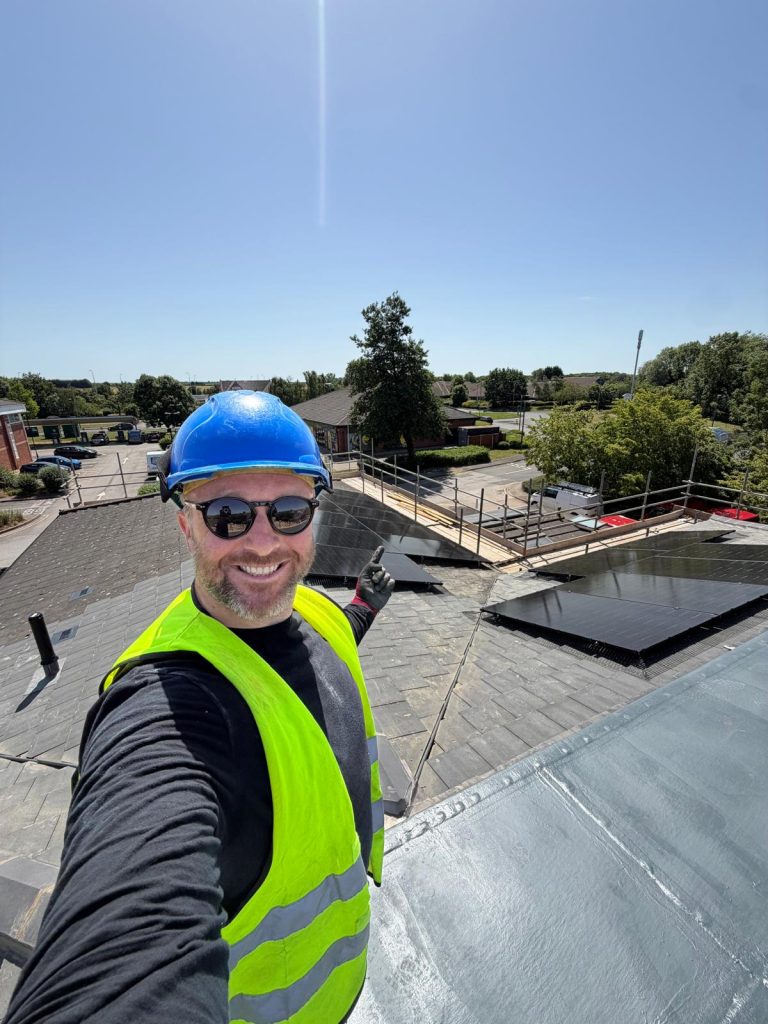
Large commercial buildings often have substantial roof areas that can provide opportunities for solar PV installation. Warehouses, industrial units, agricultural buildings and other large premises may therefore be suitable candidates for commercial renewable energy systems.
However, having a large roof does not automatically mean that a property is suitable for solar.
The building, roof condition, electricity consumption, electrical infrastructure and future energy requirements all need to be considered before a system is designed.
AZM Energy provides commercial and industrial renewable energy services alongside electrical installations, battery storage and EV charging.
Why Large Buildings Can Be Suitable for Solar PV
Large buildings can provide significant roof space for solar panels.
This can be particularly relevant for businesses that have substantial daytime electricity requirements.
Potential commercial properties include:
- Warehouses
- Factories
- Industrial units
- Agricultural buildings
- Workshops
- Retail premises
- Offices
- Distribution facilities
The suitability of the building will depend on factors such as roof construction, orientation, shading, available space and electricity demand.
A professional assessment is therefore important before deciding how a solar system should be designed.
Roof Space Is Only One Part of the Assessment
It can be easy to assume that a large roof automatically means a large solar installation.
However, not every section of a roof will necessarily be suitable.
The assessment may need to consider:
- Roof condition
- Available installation area
- Roof orientation
- Shading
- Structural considerations
- Existing equipment
- Access
- Electrical infrastructure
- Building usage
Understanding these factors can help determine the practical installation area.
Matching Solar Generation With Business Usage
The electricity requirements of a commercial building should be considered when planning solar.
A warehouse may have lighting, refrigeration, machinery, computers, ventilation systems or other equipment operating throughout the day.
An industrial property may have larger electrical loads associated with manufacturing equipment.
The solar system should therefore be designed around the building’s actual energy requirements rather than simply installing as many panels as possible.
AZM Energy provides commercial solar solutions designed around individual customer requirements.
Industrial Electrical Requirements
Large commercial and industrial buildings may use more complex electrical systems than smaller properties.
Three-phase electrical installations may be relevant where larger electrical equipment and loads are involved.
AZM Energy provides electrical installations covering single-phase and three-phase systems, as well as EICRs, consumer units, third-party certification and fault finding.
Considering these requirements alongside solar can help ensure that the renewable energy project is planned as part of the building’s wider electrical infrastructure.
Battery Storage for Large Commercial Properties
Large businesses may also want to consider battery storage alongside solar.
Solar generation and business electricity consumption do not always occur at exactly the same time.
Battery storage can provide a way to store suitable surplus solar energy for later use.
AZM Energy provides Commercial Battery Storage alongside commercial solar services.
Whether battery storage is suitable will depend on factors including electricity consumption, solar generation, operating patterns and the wider energy requirements of the business.
Agricultural Buildings and Solar
Agricultural buildings can also provide opportunities for solar PV.
Large farm buildings, barns and other agricultural premises may have substantial roof areas, while agricultural operations can have their own electricity requirements.
AZM Energy provides Agricultural Solar PV for customers considering renewable energy solutions for agricultural properties.
The suitability of a particular building still needs to be assessed professionally before an installation is planned.
Solar for Different Commercial Buildings
A solar system for a warehouse may not be designed in the same way as a system for a manufacturing facility.
Likewise, an agricultural property may have different energy requirements from an office building.
This is why businesses should consider:
- How much electricity the building uses
- When electricity is consumed
- Available roof space
- Existing electrical capacity
- Future electricity demand
- Battery storage
- EV charging
- The type of commercial activity taking place
A system designed around these factors can be more appropriate than a standard approach.
Planning for EV Charging at Large Sites
Large commercial properties may also have space for employee, customer or fleet EV charging.
If a business is considering EV charging alongside solar, the additional electrical demand should be considered during the planning stage.
Solar PV, battery storage and EV charging can potentially be incorporated into a wider energy strategy, depending on the building and its electricity requirements.
This is particularly relevant for businesses planning to expand their electric vehicle fleet in the future.
Local Commercial and Renewable Energy Services
AZM Energy serves businesses and customers across several areas.
Businesses looking for renewable energy services in Derby can explore Renewable Energy Derby, while customers considering solar can view Solar PV Derby.
For energy storage in the area, businesses can explore Battery Storage Derby, while commercial customers can view Commercial Solar Derby.
In Burton-on-Trent, local solar services include Solar PV Burton upon Trent and Solar PV Installation Burton upon Trent.
Businesses considering energy storage can explore Battery Storage Burton upon Trent, while broader renewable energy requirements are covered through Renewable Energy Burton upon Trent.
For customers in Stoke-on-Trent, AZM Energy provides Renewable Energy Stoke-on-Trent and Solar PV Stoke-on-Trent services.
Businesses in Stafford can explore Battery Storage Stafford, Renewable Energy Stafford and Solar PV Stafford.
For businesses and property owners in Newcastle-under-Lyme, local options include Renewable Energy Newcastle-under-Lyme, Battery Storage Newcastle-under-Lyme and Solar PV Newcastle-under-Lyme.
Businesses can also explore AZM Energy’s broader Commercial Solar PV services.
Looking Beyond Solar Panels
For large commercial properties, solar should not necessarily be viewed as a standalone technology.
Businesses may also need to consider:
- Battery storage
- EV charging
- Electrical upgrades
- Energy monitoring
- Maintenance
- Future building expansion
- Changes in electricity demand
Planning these requirements together can help businesses make more informed decisions about their energy infrastructure.
Professional Assessment Before Installation
A professional site assessment can help determine whether a warehouse, industrial building, agricultural property or commercial premises is suitable for solar.
The assessment can consider the building, roof, electrical installation and energy requirements before a system is designed.
AZM Energy’s services cover commercial solar, battery storage, EV charging and wider electrical work, allowing these areas to be considered together where appropriate.
Conclusion
Large commercial and industrial buildings can provide valuable opportunities for solar PV, particularly where suitable roof space and daytime electricity demand are available.
However, the right system depends on far more than roof size.
Roof suitability, electricity consumption, electrical infrastructure, battery storage, EV charging and future requirements should all be considered before installation.
AZM Energy provides commercial and industrial renewable energy solutions alongside electrical services, battery storage and EV charging. Its approach allows businesses to consider their wider energy requirements when planning a solar project.